
I'm Valur Svansson.
I turn ideas into things that hold.
An applied behavioural scientist, business executive and technical architect. Thirty-five years making strategy real for the most complex organisations on earth. Now turned on the relationship that decides every other one: the one you have with yourself. Yes. You.
How to work togetherThe strategy will only take you as far as your self-honesty will allow.
I have spent a working lifetime in rooms where the strategy was brilliant and the execution was real and the results still did not hold. Not because the thinking was wrong. Because the person making the decisions had not yet been honest with themselves about where they actually stood.
Self-trust is not a personality trait. It is not confidence, not optimism, and not a product you can buy. It is a measurable gap between where you are and where you can be honest about it. That gap is closeable. That is what BOAN.ink does.
The man behind the practice.
By education and by experience, an applied behavioural scientist. By track record, someone who has spent the 1990s, 2000s, 2010s and 2020s turning strategy into things that actually hold, for businesses from Fortune 500 to founder-stage. By origin, Icelandic; American by education, early profession and executive career, then a global remit in CX consulting and technology strategy. By base, the United Kingdom.
This practice exists because the tools that work on organisations work on people too. And nobody had pointed them there yet.
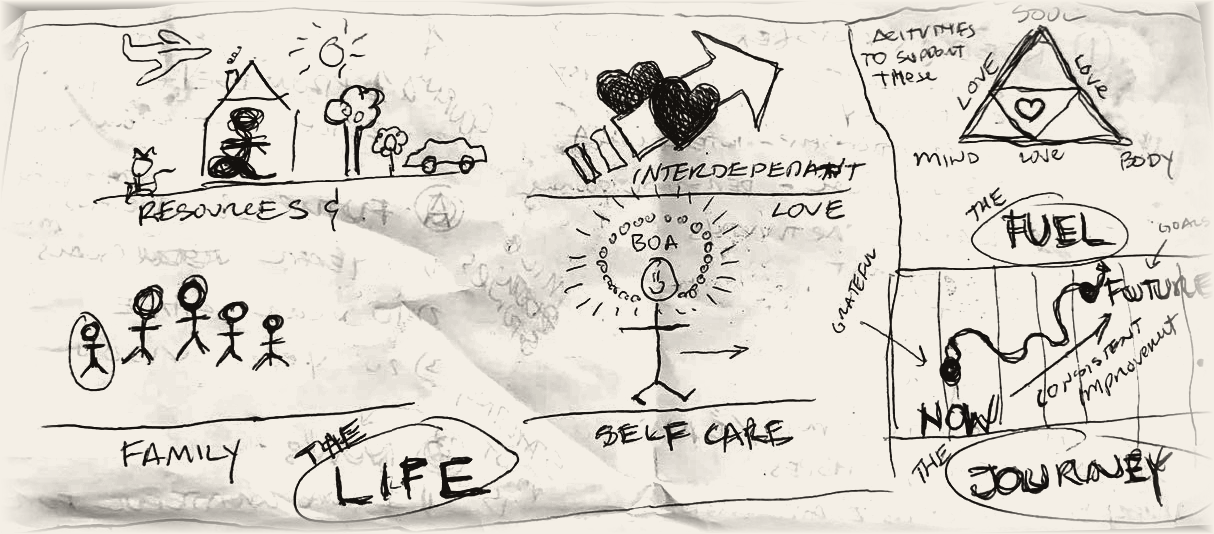
Before the practice, there was the napkin.
I did not arrive at BOAN.ink through a plan. I arrived through decades of something that looked like a plan from the outside and felt, from the inside, like a series of honest questions I could not quite stop asking.
I am from Iceland. I left. I built a career in applied behavioural science and customer experience across Europe and the world, spending decades inside the most complex organisations, learning to measure what was actually happening and close the gap between what leadership believed and what was true.
The best strategy I ever designed could only travel as far as the honesty of the person executing it. I kept running into that ceiling. Then one evening I realised I had never measured my own.
On 20 September 2019, at a restaurant in London, I drew the four pillars on a napkin. LIFE, FUEL, TRUTH, JOURNEY. The structure was complete in one sitting, and it has not changed since. The original napkin still exists. That is not sentiment. That is evidence that the idea was whole when it arrived.
What it took all those years to learn: the same apparatus that works on a business, the measurement, the feedback loops, the behavioural science, works on a person. Nobody had pointed it there. That is what BOAN.ink does.

This is how I, and everyone else, present themselves when they have not structured their life to remove the biggest blocker of success:
- — To lack courage
- — To be honest with the self,
- — To thus trust the self,
- — to fully unmask the self
- — to finally see beyond the self,
- — to clearly know tomorrow | today
How would having that ability make you feel every day?
I am not naturally self-aligned. That is why I know this works.
I have spent most of my life very good at understanding systems and very slow at turning that understanding on myself. The practitioner who builds instruments to close other people's gaps is often, quietly, the last person to close their own.
Self-trust was not my natural state. The practice that became BOAN.ink is the one I needed first. The Gate exists because I needed an honest account of where I stood before I could trust the direction I was building toward. That is how I know the instrument is real: it had to work on me before it could work on anyone else.
This is what self-trust looks like for me. What does it look like for you?
Three things I have had to learn to distinguish from one another. Most people conflate them. The whole practice lives in the space between them.
Self-Honesty
Not the confession. Not the self-criticism. Seeing what is actually there without the editorial your ego runs every time something uncomfortable comes into view. For me, this took the most time. It is also the whole game — everything else is downstream of whether this one is true.
Self-Alignment
The state where what you say, what you decide, and what you actually do are not contradicting each other in ways you are quietly aware of but not naming. Most misalignment is not hidden. It is simply unlabelled. Name it, and the gap becomes workable. That is what the Blueprint does.
Self-Trust
Not confidence. Confidence is social; it depends on an audience. Self-trust is the private one: the capacity to make a decision and not immediately negotiate with yourself about whether you were right. It is built in the programme, not measured in the Gate. The sequence matters.
Early testers. Real words.
The first cohort completed the Root Self Assessment and the reading in June 2026. These are their responses, unedited.
The reading found something I had known was there but had not named. I did not expect it to be that accurate or that fast. It landed.
I went in thinking this was a personality test. It is not. It asked me questions I did not know I had been avoiding. That is a different thing entirely.
Thirty minutes. A verdict I disagreed with for about three minutes, and then could not argue with. The divergence between what I said and what the engine read was exactly the thing I needed to look at.
One way of thinking. Several ways in.
The same applied behavioural science runs through everything here: the individual practice, the keynote, the AI consulting, the boardroom. The entry point depends on what the work requires.
The process always begins with an honest read. Whether the subject is a person, a team, or an organisation, the question is the same: what is actually happening, and what gap needs closing before anything else can hold?
All of that thinking can continue between sessions, through an add-on, bespoke knotomo.hi decision engine: something that knows you, your schedule, your preferences and your goals. It becomes your Jiminy Cricket, the voice of truth, for any Pinocchio still left in you.
For individuals & couples
The Root Self Assessment, the BOAN Self Blueprint, and the full programme. Begin with the Gate.
Begin →The whole path, in order
From the Read through the Map to the Work. Nothing hidden, and no pitch before the honest picture is given.
See the path →For leadership & founders
On self-trust, applied behavioural science, the decisions that compound, and the loops that cost you before you see them.
Enquire →For organisations
Customer experience design, journey mapping, operational optimisation, and AI agentic systems. Intelligence embedded, not bolted on, from SMB to enterprise.
Get in touch →